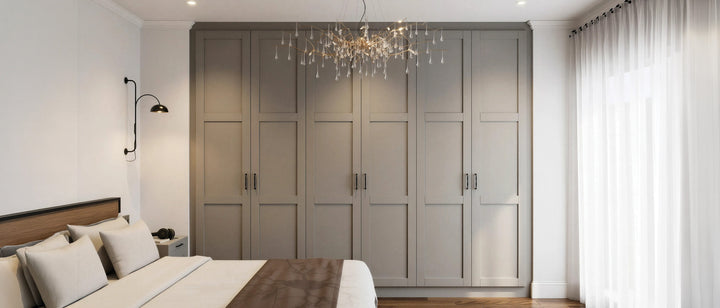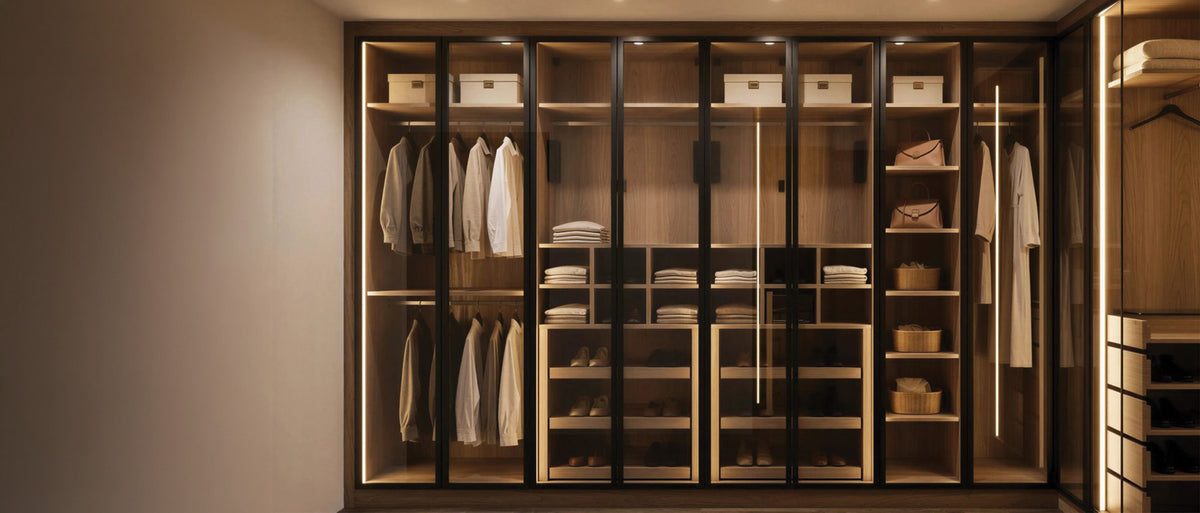
Bedroom ceiling lights are behind you when you open a wardrobe, so the inside of most wardrobes is in your own shadow. Lighting the interior is the cheapest upgrade with the largest daily effect: you see what you own, colours read true and the room gains a soft secondary light in the evening. This guide covers where lights go, what kind, and what they cost.
Wardrobe lighting, in short
- Sensor-operated LED strips come on as the door opens and off as it closes.
- Vertical strips down the inside of the side panels light hanging best; strips under shelves light folded clothes and shoes.
- Warm white (2,700 to 3,000K) flatters a bedroom; neutral white (3,500 to 4,000K) shows colour most accurately for dressing.
- Wired in during installation, switched or sensor-operated; around £100 per light.
- Lit niches, dressing tables and glass-fronted wardrobes turn lighting into the design.
Where the light should come from
A single strip across the top of a wardrobe lights the top shelf and leaves the hanging in shadow. The fitting that works is a vertical LED strip recessed into the inside face of each side panel, so light falls along the length of the hanging clothes and down to the drawers. In a bay of shelves or shoes, short strips under each shelf front light what sits on the shelf below. In a drawer bank a strip in the top drawer opening is enough. Because the strips are specified with the carcase, the channel is machined into the panel at the workshop and the profile sits flush.
Sensor or switch
Door-contact or motion sensors switch the light on as the door opens and off when it closes, so nothing is left burning. For open dressing areas and walk-ins a wall switch or a dimmer on the room circuit is better, so the lighting becomes part of the room's evening light. Both are wired during installation by our own team.

Warm or cool white
Colour temperature is the decision people get wrong. Warm white, around 2,700 to 3,000K, matches the rest of a bedroom and flatters wood and painted interiors. Neutral white, 3,500 to 4,000K, is truer for telling navy from black at seven in the morning. Most clients choose warm white for a bedroom wardrobe and neutral white for a dressing room or a mirror light. Avoid anything above 4,000K; it reads as an office.
Lighting as design
Once the interior is lit, the wardrobe can be opened up. A lit display niche in a run of closed doors, an oak recess between two painted wardrobes with a shelf and drawers below, is the single most requested feature in our bedroom projects. Glass-fronted doors over a lit walnut interior turn a wardrobe into a display case. A lit dressing table set into the run gives a place to sit and a mirror with proper light on the face rather than behind it.
Practicalities
- LED strips run cool, use very little power and last longer than the wardrobe will.
- A driver is concealed in a top box or plinth; power comes from a nearby socket or a spur added by your electrician before installation.
- Lighting is itemised on the quotation at around £100 per light and carries its own electrical component warranty alongside the 10-year furniture guarantee.
- Mention lighting at the design visit: channels are cut at the workshop, and adding them later means removing panels.
Frequently asked questions
How do you light the inside of a wardrobe?
With sensor-operated LED strips recessed vertically into the inside of the side panels for hanging, and short strips under shelves for folded clothes and shoes. They switch on as the door opens.
What colour light is best for a wardrobe?
Warm white, around 2,700 to 3,000K, matches a bedroom and flatters interiors. Neutral white, 3,500 to 4,000K, shows colour most accurately and suits dressing rooms and mirror lights.
How much does wardrobe lighting cost?
Around £100 per light when wired in during installation, itemised on the quotation. Lighting is included from Level 4 of our price guide and optional at Levels 1 to 3.
Can lighting be added to an existing fitted wardrobe?
Sometimes, with surface-mounted battery or plug-in strips, but recessed lighting is best specified with the carcase so the channels are machined at the workshop.
Explore Metro
Ready to see what your room could hold?
Book a free home design visit. A Metro designer measures the room, brings full-size door and finish samples, and returns a 3D design with an itemised, fixed price within two to three days. No deposit is taken at the visit and there is no obligation. Or see every door style at our Wembley showroom, next to the workshop that makes them.