
Window seating
Window seats built into the bay or the reveal, with drawers or a lift-up lid beneath and bookcases or wardrobes either side. Templated to your window, made to measure in our London workshop and fitted by our own team within 21 days of your order.
Almost every bay has a radiator under it, and it is the first thing people assume rules out a seat. It does not: the radiator can be moved, replaced with a slim vertical one, or kept behind a grille in the seat front, and your designer will say which is practical. A window seat between bookcases makes a reading corner; between wardrobes it finishes a bedroom run; in a bay it becomes a day-bed with storage. The joinery around it comes from the same door library and paint as the rest of the room, so it matches a media wall or a chest of drawers.
Every seat starts with a free home design visit, is made in our Wembley workshop and guaranteed for ten years, with prices including VAT and installation. See the three seats below, the price guide or the inspiration gallery.
- Made in our Wembley workshop
- 10-year guarantee
- Fitted in 21 days
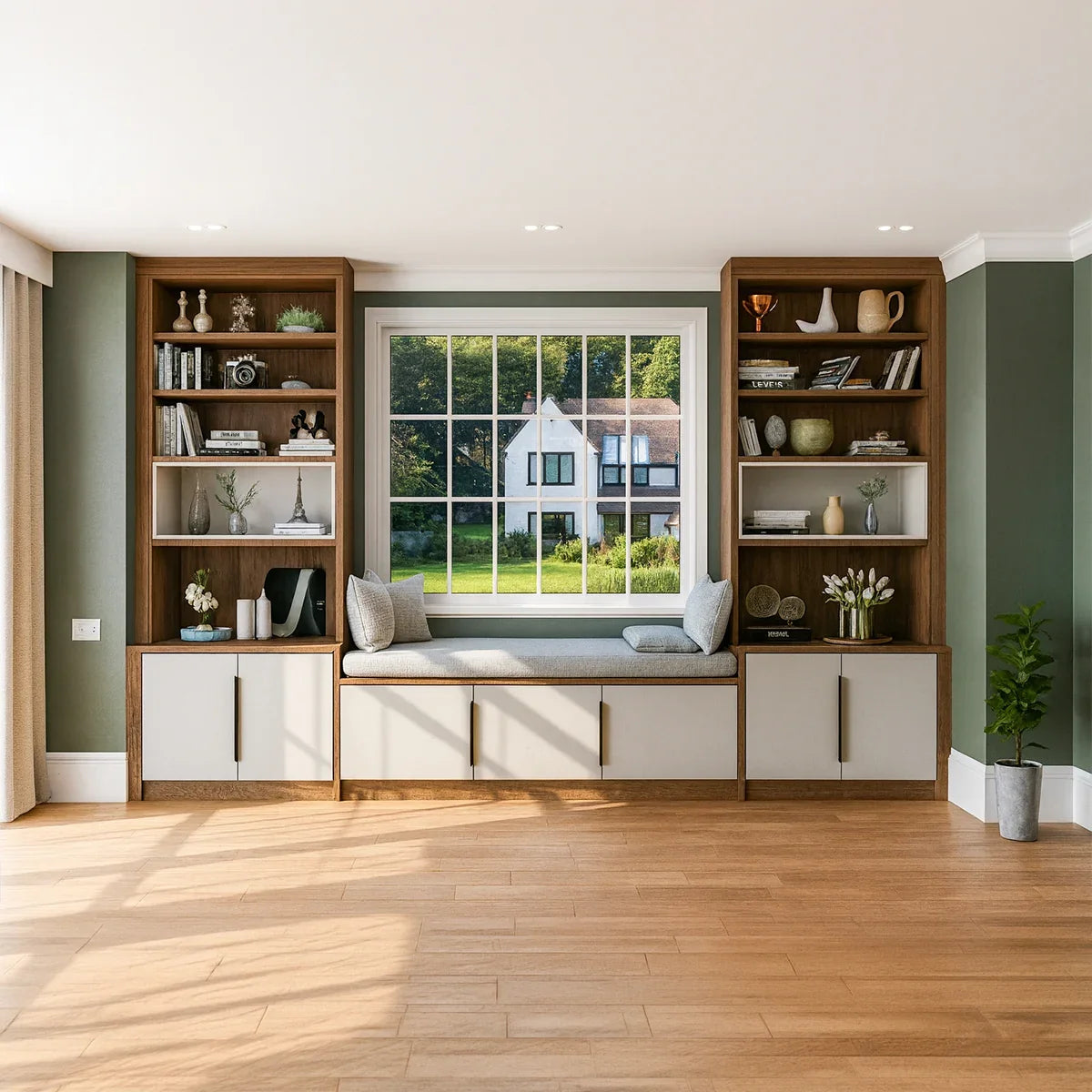
Three seats,three windows.
A library seat between bookcases, a bedroom seat between wardrobes, and a bay window day-bed. Each is drawn to the window it sits in; the joinery around it is drawn to the room. Click any image to open the design.
3 designs · click any image to open it


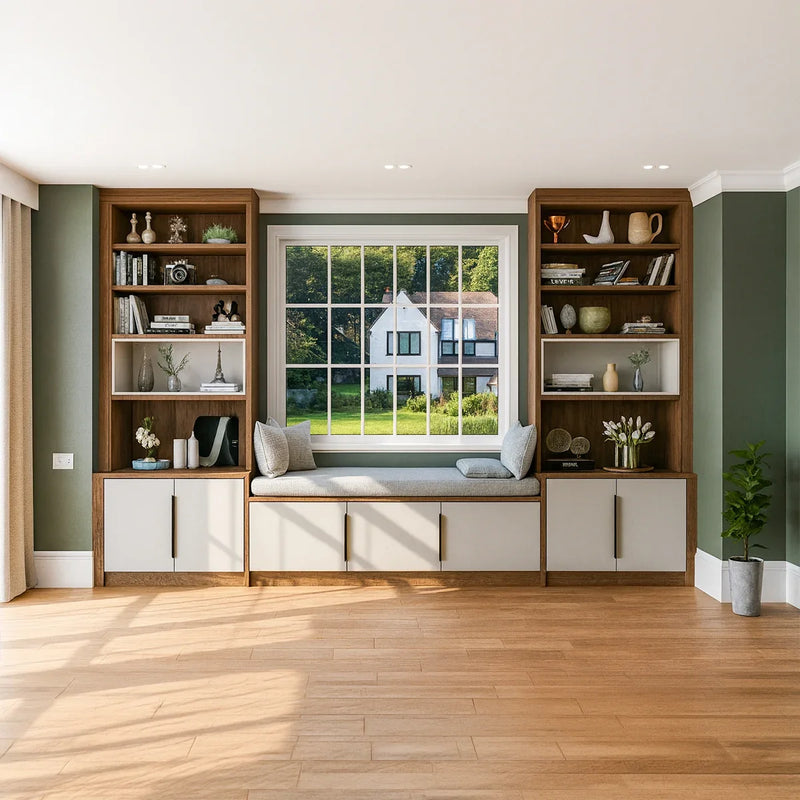
Ludlow Library Window Seat London
Ludlow — full-height walnut bookcases flanking the window, a cushioned seat spanning between them over three cupboard doors, open shelves w…
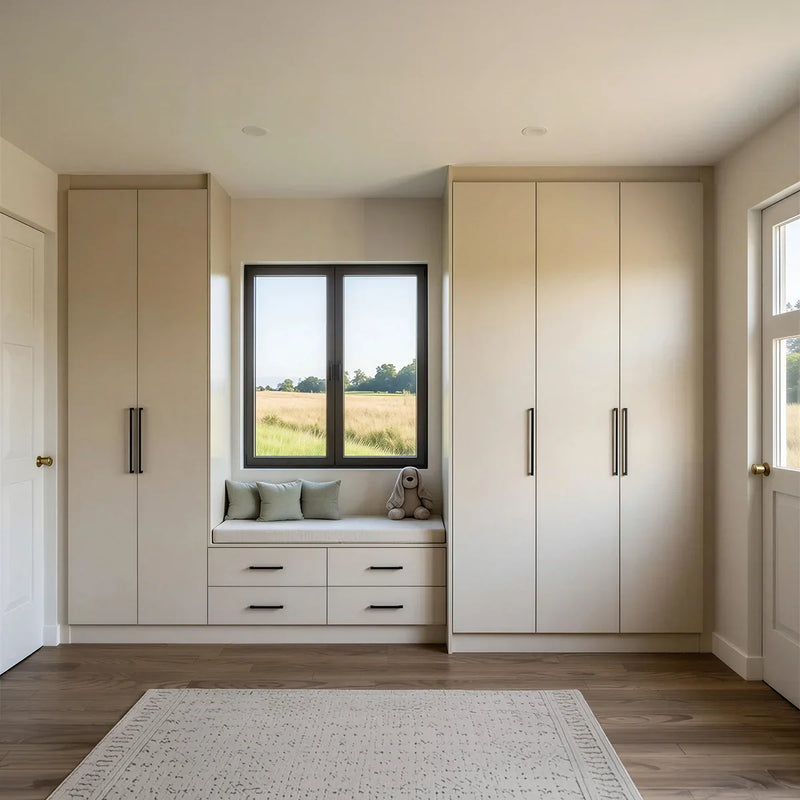
Hampton Window Seat with Wardrobes London
Hampton — two full-height cashmere slab wardrobes either side of a bedroom window, with a cushioned seat over four drawers spanning the sil…
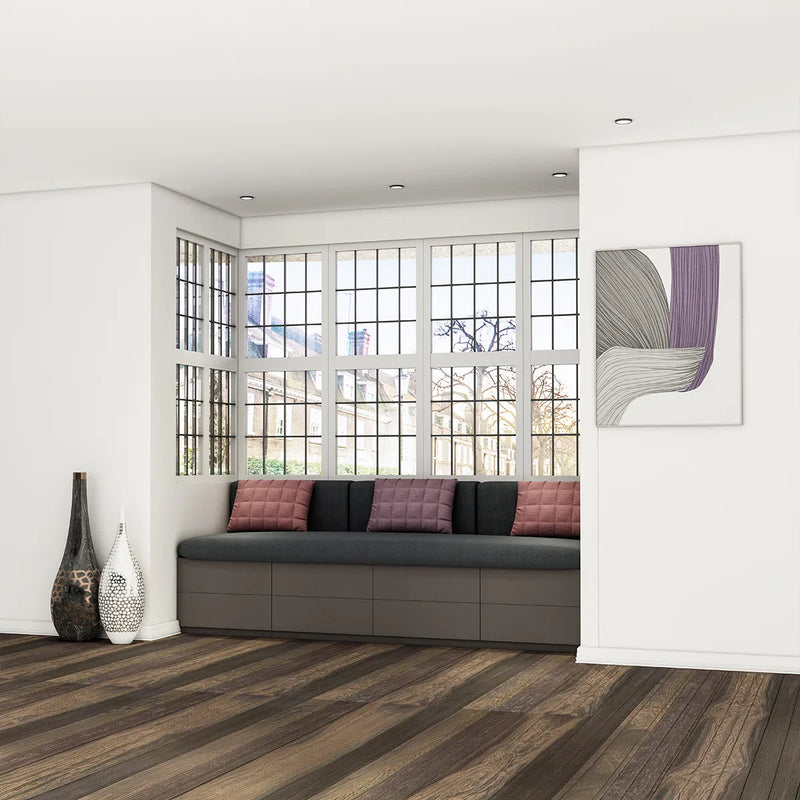
Ashdown Bay Window Seat London
Ashdown — a grey upholstered day-bed built into an angled bay, mattress-depth, with a bank of deep push-to-open drawers beneath in graphite…

The best light in the room,
and nowhere to sit in it.
A window is the one part of a wall that furniture cannot go in front of, so the wall with the best light usually has the least in it: a radiator, a sill, and a gap the sofa cannot fill. A fitted window seat uses that gap. Built into the bay or the reveal, at sill height, with storage beneath it, it gives the room a place to sit in the light and takes a chest of drawers off another wall.
Bays are the reason to build one bespoke. No two returns of a London bay are the same angle, and a standard bench leaves a wedge of gap at each one. We template the bay, cut each carcass to it, and run one solid top across them. The radiator under the window, the thing most people assume rules a seat out, is dealt with at the design visit.
Four decisions that make a window seat.
The seat
About 450mm high with the cushion, the same as a chair, and 450mm to 500mm deep for sitting upright, 600mm for sitting sideways with your legs up, 750mm or more for a day-bed. The seat is a solid 18mm board on its own carcass, set off the cold wall behind it, never a lid on a box.
The storage
Drawers on full-extension runners, which open without lifting the cushion, or a lift-up lid on soft-close stays, which gives one big volume for bedding and board games. Drawers cost a little more and are the better choice for anything used weekly.
The radiator
Almost every bay has one, and it does not rule a seat out. Relocate it to a side wall, replace it with a low-level model behind a ventilated grille in the seat front, or build the seat around it with a slotted panel for the warm air. Your designer checks which is practical.
The joinery either side
Bookcases, wardrobes or cupboards that frame the window and carry the seat between them. This is what turns a bench into a feature, and because it is made in the same workshop the finish, the handles and the detailing match across the run.
Specified for the coldest wall in the house.
Templated to the bay
Curved or angled, the bay is templated on site including the angle of each return and any difference between the two sides, which in a period house is more than you expect. Every carcass is cut to it.
Ventilated at the back
The seat carcass is set off the external wall with a gap that lets air move behind it, so the reveal does not sweat. Where a radiator sits inside the seat, the front carries a grille so the heat gets out.
A seat, not a lid
The top is a solid 18mm board on solid-back carcasses, built to be sat on, stood on and lain on. The cushion is a firm foam core with a fibre wrap, made to the seat, in a hard-wearing fabric with a removable cover.
Soft-close throughout
Drawers on full-extension runners that glide back on their own, doors on concealed hinges, lift-up lids on stays. Handles in brass, black, a knob or push-to-open, picked from the samples at your visit.
Scribed to the reveal
The seat and the joinery either side are scribed to the window reveal, the skirting and the walls on installation, so the run meets the room without filler strips or gaps.
10-year guarantee
Every carcass, drawer, hinge, lift-up stay and finish is covered for ten years, parts and labour. The people who built the seat fitted it, so one phone call deals with anything that ever needs looking at.
The radiator under your window
Almost every bay in a British house has a radiator under it, and it is the first thing people assume rules out a window seat. It does not. There are three workable answers and your designer will assess which is practical during the visit.
Relocate it. Your plumber moves the radiator to a side wall. This is the cleanest result and usually the cheapest of the three, provided the pipework run is reasonable.
Replace it. A low-level or plinth-height radiator fits beneath the seat behind a ventilated grille front. You keep the heat output and the seat sits at normal height above it.
Build around it. The seat is drawn around the existing radiator with a slotted or grille panel allowing convection. This is the least disruptive option and the one most people choose.
Whichever route you take, a grille front is essential rather than optional where a radiator sits within the seat — a sealed box loses most of the heat output into the storage void.

From bay template to installed handover.
A window seat is a single run in a single bay, so it is one of the shortest jobs we do: three weeks at most from order to installation, and normally a day on site.
Guides from our designers

Fitted Wardrobes for Small Bedrooms: 12 Ideas That Add Storage Without Losing Floor
Small London bedrooms need storage that goes up, not out. Twelve fitted-wardrobe ideas our designers use in b…
Read the guide
Fitted Bedroom Furniture: Planning a Whole Room, Not Just a Wardrobe
A wardrobe is one wall. Fitted bedroom furniture is the whole room in one finish: bedsides, a dressing table,…
Read the guide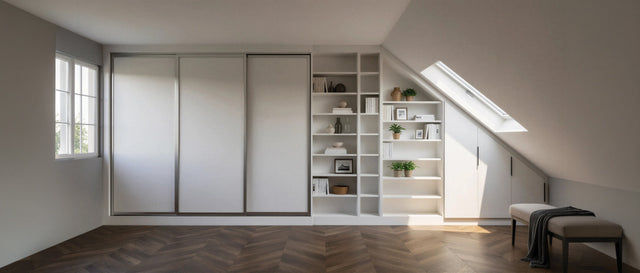
Loft Wardrobes: How to Fit Storage Under a Sloping Ceiling
A loft conversion has more storage in it than any other room in the house, all of it in the awkward wedge und…
Read the guide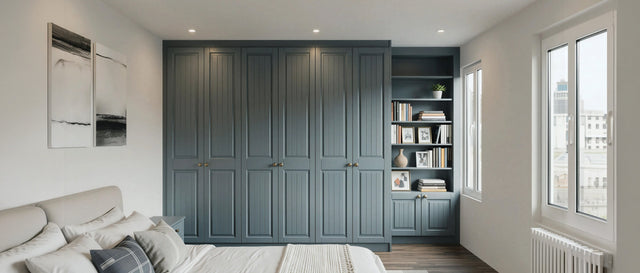
Alcove Storage Ideas: Fitted Cupboards and Shelving Either Side of a Chimney Breast
The alcoves either side of a chimney breast are the most useful 600mm in a London house. What to build in the…
Read the guideTrusted by London homeowners
“A wonderful experience from start to finish. I designed four wardrobes — the team's expertise and flexibility were outstanding. Every person I dealt with was warm, professional and genuinely invested in getting it right.”
“Great fitted wardrobe looks amazing, quality of workmanship is outstanding the designed is just what i wanted. Time frame of installation is very quick. Customer service was spot on from the start even after installation they checked to see if I was happy. Would highly recommend Metro Wardrobes.”
“Hiren and Ajay very professional and efficient service. Finished the job on time and very well made. Left the space clean. Will 100% use them again! Thank you”
Questions clients ask at the first home visit.
A bespoke window seat is fitted joinery built into a window recess or bay to create seating where there was previously dead space, almost always with storage underneath. Because bay windows are rarely symmetrical — particularly in Victorian and Edwardian houses — the seat is templated to the actual bay rather than assembled from standard units, so it meets the walls cleanly on both sides.
A straightforward straight-run window seat with lift-up storage starts from around £1,800. Curved bay seats, drawer storage instead of lift-up lids, and integrated radiator solutions run higher, typically £1300 to £2000. Upholstered cushions are included with the seat. Every seat is priced after a home visit, since bay geometry drives the cost more than length does.
Around 450mm high including the cushion, which matches standard chair height and is comfortable for most people to sit down onto and rise from. Depth of 450mm to 500mm suits sitting upright; 600mm or more allows you to sit sideways with your legs up, which is what most people actually want from a window seat. We confirm both during the home visit.
Yes, and virtually all of ours do. There are two approaches: a lift-up lid on soft-close stays, which gives one large volume ideal for bulky items like bedding and board games; or drawers, which cost more but let you reach things without moving the cushion and anything sitting on it. Drawers are the better choice for items you use weekly.
Yes. Curved and angled bays are the most common brief and the main reason to build bespoke — a standard bench cannot follow the geometry, so it leaves triangular gaps at each return. We template the bay on site, including the angle of each return and any variation between the two sides, which in a period property is usually greater than people expect.
This is the most common obstacle and there are three workable answers. The radiator can be relocated by your plumber, usually to a side wall. It can be replaced with a low-level or plinth-height model that fits beneath the seat with a ventilated grille front. Or the seat can be built around it with a slotted panel allowing convection. Your designer assesses which is practical.
It can if built as a sealed box against a cold external wall, so we design for airflow — ventilated backs or plinth gaps that let air circulate behind the seat and against the window reveal. Where a radiator sits within the seat, a grille front is essential rather than optional, otherwise you lose most of the heat output into the storage void.
Yes, and flanking storage is what turns a window seat from a bench into a feature. The most common arrangement is full-height cupboards or bookcases either side of the bay with the seat spanning between them, which frames the window and gains substantial storage. Because everything is made in the same workshop, the finish, handles and detailing match across the whole run.
A foam core of 50mm to 75mm with a fibre wrap gives the right balance — firm enough to sit on comfortably for a long stretch, soft enough not to feel like a bench. Choose a hard-wearing upholstery fabric rather than a curtain-weight one, and consider fade resistance, since a window seat sits in direct sunlight for hours a day. Removable, washable covers are worth specifying.
No permission is needed — a window seat is internal joinery, not a structural alteration. The exception is listed buildings, where internal joinery affecting a period window reveal may require listed building consent, so check with your local conservation officer first. Every Metro window seat carries the 10-year guarantee on parts and labour, covering carcasses, mechanisms, lift-up stays and finishes.
The best seat in the house, in the best light.
Book a free home visit. Our designer templates the bay, checks the radiator and leaves you with a sketch of the seat.