You will touch your wardrobe handles ten thousand times before the doors need repainting, so they deserve more than the last five minutes of a design visit. This guide covers the five handle types, which suits each door, how they are positioned, and when the best handle is no handle at all.
Handles, in short
- Bar handles: the modern default, slim and easy to grip; brass or black on most doors.
- Knobs: for shaker and in-frame doors; centred on the stile.
- Cup handles: drawers and dressing units, traditional rooms.
- Edge pulls and J-pulls: a recess machined into the door edge; the handleless look with something to hold.
- Push-to-open: no hardware at all; best on slabs and gloss.
- Black hardware upgrade is around £220 per wardrobe; standard finishes are included.
Match the handle to the door
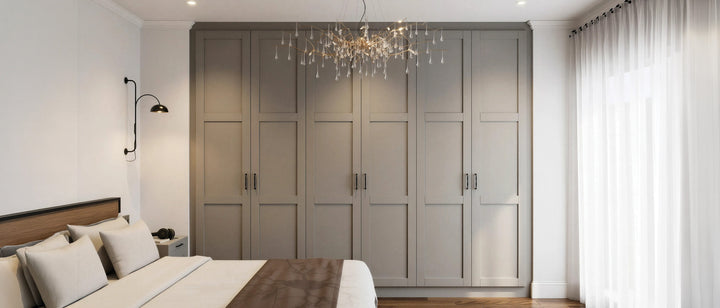
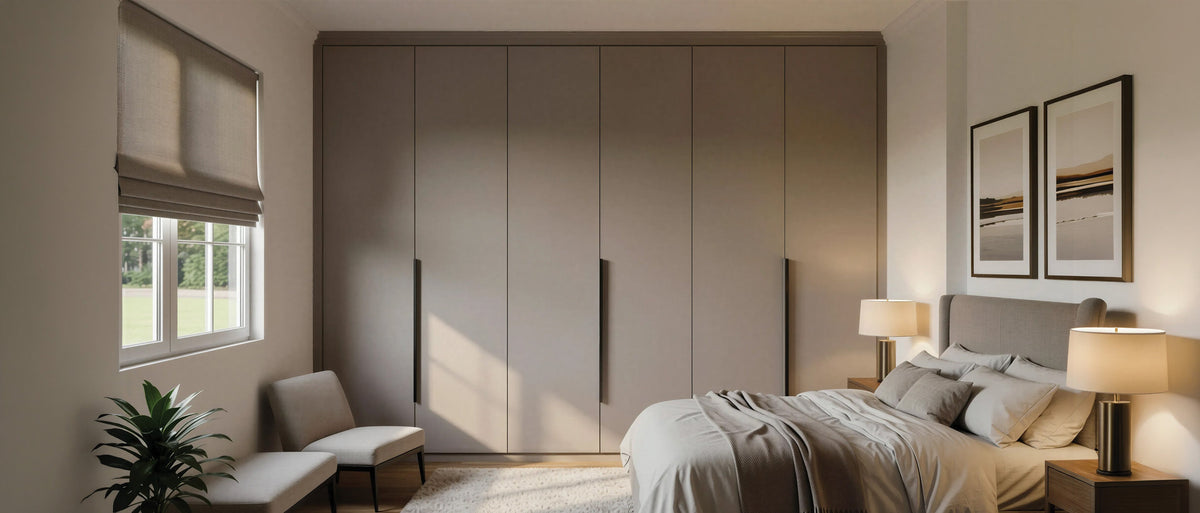
Shaker and in-frame doors want a knob or a short bar centred on the stile: the frame is the detail and the handle should sit inside it. Slab doors take long bars, which lengthen the door, or no handle at all. Fluted and grooved doors need a slim bar that does not fight the pattern, or a recessed pull. Glass and mirror doors take a frame-edge pull so nothing is fixed through the glass. Drawers suit cup handles in traditional rooms and short bars in contemporary ones.
Metal finishes
Brushed brass is the finish London clients ask for most, and it earns the fuss on sage, cream, navy and black doors. Matt black sharpens white, grey and oak. Brushed steel and chrome suit gloss and cool greys. Bronze sits between brass and black and flatters woodgrains. Use one metal per room where you can; if the light fittings are black, black handles will look intended.

Position and size
On a full-height door the handle sits roughly 1,000 to 1,100mm from the floor, at the height your hand falls naturally. On a pair of doors the handles mirror each other so they read as one detail. Long bars on slab doors are usually a quarter to a third of the door height; a bar that runs almost the full height reads as a design statement and suits handleless-looking runs. Knobs on shaker doors sit in the centre of the stile, level with the top of the panel's lower third.
Going handleless
Three routes give a clean face. A J-pull is a curved recess machined into the top or side edge of the door, so you hook your fingers in; it keeps the shaker frame intact on our Lane door and makes a slab read as one plane. An edge grip is a short recessed pull at mid-height, firmer in the hand than a groove. Push-to-open uses a catch so a light press releases the door; it is the purest look and the one that shows fingerprints most on gloss, so pair it with super-matt.
Handles on sliding doors
Sliding doors are pulled by their frames, so the handle is usually a recessed profile in the aluminium stile or a slim vertical bar. Black frames with a bronze mirror and a recessed pull are the most requested sliding combination.
Cost
Standard handles are included in the price of every level. Upgrading to black hardware, rails, hinges and handles, is around £220 per wardrobe; solid brass and specialist pulls are itemised on the quotation. Handles are one of the few things that can be changed later, so if in doubt choose the plainer option now.
Frequently asked questions
What handles look best on shaker wardrobes?
Round knobs or short bars centred on the stile. Brass suits cream, sage and navy shaker doors; black suits white and grey.
Are handleless wardrobes practical?
Yes, with the right mechanism. A J-pull or edge grip machined into the door gives you something to hold; push-to-open works well on super-matt slabs but shows fingerprints on gloss.
Where should wardrobe handles be positioned?
Around 1,000 to 1,100mm from the floor on full-height doors, mirrored on pairs so they read as one detail. Knobs on shaker doors sit centred on the stile.
Can I change the handles on fitted wardrobes later?
Usually yes, provided the new handle uses the same fixing centres or the door is drilled again and the old holes filled. Choosing a plain handle now keeps that option open.
Ready to see what your room could hold?
Book a free home design visit. A Metro designer measures the room, brings full-size door and finish samples, and returns a 3D design with an itemised, fixed price within two to three days. No deposit is taken at the visit and there is no obligation. Or see every door style at our Wembley showroom, next to the workshop that makes them.