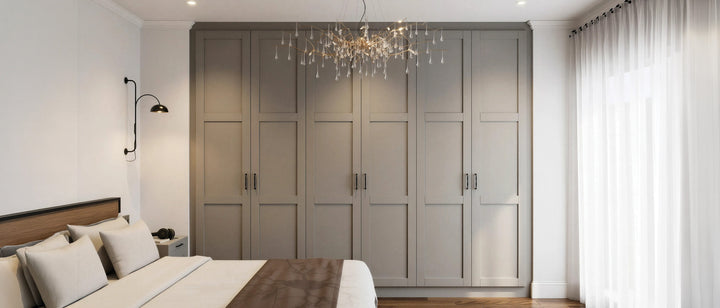
Most wardrobe disappointment happens inside. A run that looks perfect from the bed but holds a single rail and two shelves stores less than the freestanding unit it replaced. This guide sets out the dimensions and fittings our designers use to plan an interior around what you actually own, and what each option costs.
Interior planning, in numbers
- Long hanging (coats, dresses): 1,500 to 1,700mm clear drop.
- Double hanging (shirts, jackets, trousers folded over): two rails at about 1,000mm and 2,000mm.
- Shelf depth 350 to 400mm for knitwear; drawers 150mm for smalls, 200 to 250mm for jumpers.
- Shoe shelves 200mm apart, angled or flat; boots need 400mm.
- Pull-out rails, shoe racks and jewellery drawers fit within the standard unit price; premium interior boards add around £200 per wardrobe.
- Each drawer is designed for up to 30kg.
Start with a count
Before drawing, count what needs a home: metres of long hanging, metres of short hanging, pairs of shoes and boots, folded knitwear, bedding and suitcases. A designer does this with you at the visit. The commonest mistake is a wardrobe that is mostly hanging for someone who owns mostly folded clothes, or the reverse.
Hanging
Long hanging needs a clear drop of 1,500 to 1,700mm for coats and dresses; give it one bay, not the whole run. Shirts, jackets and folded trousers double-hang on two rails about a metre apart, which doubles the capacity of a bay. In a tall wardrobe a pull-down rail brings the top rail to shoulder height with a pull on a gas-assisted arm; it is the fitting people thank us for most in rooms with 2.7-metre ceilings.
Drawers and shelves
Internal drawers on soft-close runners are the difference between a wardrobe and a cupboard. Shallow 150mm drawers take underwear, socks and T-shirts; 200 to 250mm drawers take knitwear and jeans; a bank of four in one bay is the usual starting point, which is why our Essential Plus level includes four drawers. Shelves at 350 to 400mm deep suit folded clothes without them disappearing at the back; adjustable shelves on 32mm pitch let you change your mind. Every drawer is rated to 30kg.

Shoes and boots
Shoes are the item people underestimate. Angled shoe shelves at 200mm spacing show the pair and take 20 to 24 pairs in a 600mm bay; flat shelves hold more but hide the back row. Boots need 400mm of height, so a boot shelf at the bottom of the long-hanging bay is a neat solution. Pull-out shoe racks on runners bring the back row forward and fit within the standard unit price.
Ties, belts, jewellery and watches
A pull-out tie and belt rack mounts on the side of a bay and takes twenty ties and a dozen belts in 100mm of width. Jewellery trays are shallow felt-lined drawers, usually the top drawer of a bank, divided for rings, watches and necklaces; a glass top turns one into a display. These organisers are the difference between a wardrobe you use and one you fight, and they fit within the unit price.
A built-in safe
A domestic safe is easiest to hide in a fitted wardrobe: bolted through the carcase back into the wall, behind a drawer front or a shelf, invisible with the doors closed. Tell your designer at the visit so the bay is dimensioned around it and the fixing is drawn in.
Lighting the inside
Sensor-operated LED strips down the sides or under the shelves come on as the door opens, at around £100 per light. In a deep wardrobe or a dressing room they change how the interior is used. See the lighting guide.
What it costs
Pull-out rails, shoe racks and jewellery drawers fit within the standard unit price on every made-to-measure level from Level 3 at £900 per metre. A premium interior board, a walnut or oak effect in place of standard white, adds around £200 per wardrobe. The interior is where most of a good quotation's value sits, so ask to see it itemised. See the price guide.
Frequently asked questions
How much hanging space do I need in a wardrobe?
Long hanging needs a clear drop of 1,500 to 1,700mm and usually one bay. Shirts and jackets double-hang on two rails about a metre apart, which doubles the capacity. Count your clothes before the design visit.
Can I add drawers to a fitted wardrobe?
Yes. Internal drawer banks on soft-close runners are built into the carcase; a bank of four is the usual starting point and is included in our Essential Plus level. Drawers can also be added to an existing Metro wardrobe.
Can a safe go inside a fitted wardrobe?
Yes. A domestic safe is bolted through the carcase back into the wall behind a drawer front or shelf and is invisible with the doors closed. Mention it at the design visit so the bay is drawn around it.
How many shoes fit in a fitted wardrobe?
A 600mm bay of angled shoe shelves at 200mm spacing holds 20 to 24 pairs. Boots need 400mm of height; pull-out racks bring the back row forward.
Explore Metro
Ready to see what your room could hold?
Book a free home design visit. A Metro designer measures the room, brings full-size door and finish samples, and returns a 3D design with an itemised, fixed price within two to three days. No deposit is taken at the visit and there is no obligation. Or see every door style at our Wembley showroom, next to the workshop that makes them.