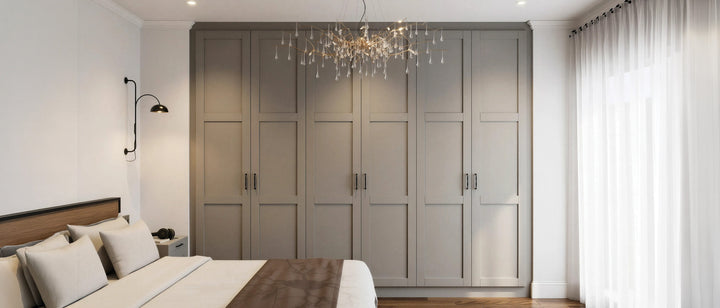
A fitted wardrobe is designed once and lived with for twenty years, so the order in which you make the decisions matters. This is the sequence our designers follow at a home visit, with what to look for at each step and the mistakes we see most often.
The eight decisions, in order
- 1. What you need to store, measured in metres of hanging and pairs of shoes.
- 2. Hinged or sliding doors, decided by the clearance in front of the wardrobe.
- 3. Door style: slab, shaker, in-frame, arched, fluted, handleless or glass.
- 4. Finish and colour, seen in your own room's light.
- 5. The interior: rails, shelves, drawers and organisers.
- 6. Lighting.
- 7. Handles or handleless.
- 8. Who makes it, and what the guarantee covers.
1. Start with your clothes, not the wall
Before a single door is chosen, count. How many metres of hanging do your long coats and dresses need? Can shirts and jackets double-hang? How many pairs of shoes live in the bedroom, and how many are boots? Where do jumpers, jeans and bedding go now? A designer does this with you at the visit, because the answers decide the layout: a wardrobe that is all hanging when you own mostly folded knitwear is the commonest mistake in the trade.
2. Hinged or sliding
Measure from the wardrobe wall to the nearest obstacle. With 600mm or more of clear floor, hinged doors open fully and you can choose any door style. With less, sliding doors keep the room usable and carry a continuous mirror. Our hinged versus sliding guide covers the trade-offs; in short, hinged for access and door detail, sliding for tight rooms and mirror.
3. Door style
Door style sets the character of the room and a good share of the price. Slab doors are the benchmark and suit contemporary rooms. Shaker frames sit at Level 6 of our price guide (£1,860 per metre against £900 for slab) and suit almost everything, from Victorian terraces to new builds. In-frame, raised-panel and arched doors lean traditional; fluted, grooved and glass doors make a statement. We group fifteen styles into Classic, Contemporary and Statement collections, and the door library explains how each is made.

4. Finish and colour, in your own light
Never choose a finish from a screen. A warm white that glows under showroom lights can turn grey on a north-facing wall. Your designer brings full-size samples to the visit for exactly this reason. Standard woodgrains and painted-effect boards are included in the price; super-matt and textured boards are a 20 to 25% upgrade that shows fingerprints less and feels softer to the touch. The colour guide and materials guide go deeper.
5. The interior
This is where the wardrobe earns its keep. Rails at the right heights for long and double hanging, drawers deep enough for knitwear, shelves for shoes at the bottom and for bags at the top, and organisers for the things that get lost: ties, belts, jewellery, watches. Pull-out rails, shoe racks and jewellery drawers fit within the standard unit price. Plan the interior from the count you made in step one.
6. Lighting
Lighting inside a wardrobe turns a dark cupboard into a shop display. Sensor-operated LED strips come on as the door opens and cost around £100 per light. In a walk-in or a dressing area they are close to essential. The lighting guide explains the options.
7. Handles
Slim bar handles, cup handles, round knobs, push-to-open or a handleless J-pull machined into the door edge. Handles are small in cost and large in effect; brass warms a cool room, black sharpens a pale one. Our handle guide pairs them with door styles.
8. Who makes it
Ask three questions of any company. Do you make the furniture yourselves, and where? Are the fitters your own employees or subcontractors? What does the guarantee cover, and for how long? At Metro the answers are our own Wembley workshop, our own employed fitters, and ten years on the furniture and the installation. The quotation is itemised and fixed before you commit, and no deposit is taken at the design visit.
Frequently asked questions
How do I decide between hinged and sliding wardrobe doors?
Measure the clear floor in front of the wardrobe. With 600mm or more, hinged doors open fully and every door style is available. With less, choose sliding doors, which need no swing space.
What is the best finish for a fitted wardrobe?
For longevity, painted shaker or soft matt slab finishes in neutral tones date most slowly. Super-matt boards hide fingerprints and feel softer. Always judge a sample in your own room, not on a screen.
How much should I budget for a fitted wardrobe?
Made-to-measure wardrobes start from £900 per metre at Level 3 including VAT and fitting, so a two-metre wardrobe from £1,800. Our price guide sets out twelve levels from £600 per unit.
What should I ask a fitted wardrobe company?
Where the furniture is made, whether the fitters are employed or subcontracted, what the guarantee covers and for how long, and whether the quotation is fixed and itemised.
Ready to see what your room could hold?
Book a free home design visit. A Metro designer measures the room, brings full-size door and finish samples, and returns a 3D design with an itemised, fixed price within two to three days. No deposit is taken at the visit and there is no obligation. Or see every door style at our Wembley showroom, next to the workshop that makes them.