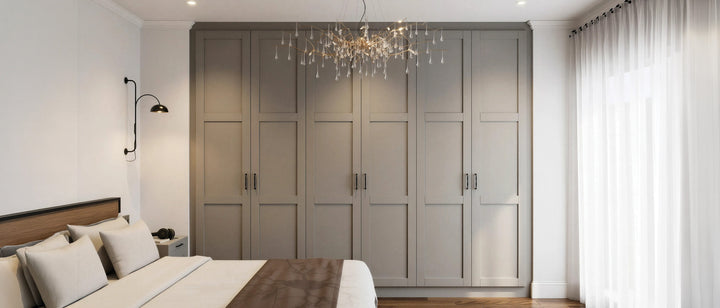
If one door style has outlasted every fashion since the 1830s it is the shaker: a flat frame around a flat recessed panel, with nothing added. It suits period London houses because it is what their joinery was, and it suits new builds because it is plain. This guide explains how a shaker wardrobe door is made, why the width of the frame changes everything, and what it costs.
Shaker, in short
- A frame (two stiles, two rails) around a recessed centre panel.
- Made three ways: routed from one board and wrapped, built as a true five-piece door, or routed and painted.
- Stile width sets the character: 60mm reads modern, 75mm classic, 90 to 105mm period.
- Shaker doors sit at Level 6 of our price guide, £1,860 per metre against £900 for slab doors.
- Pairs with knobs, cup handles or slim bars; brass and black are the current favourites.
What a shaker door is
The Shaker communities of nineteenth-century America built furniture without ornament: a frame for strength, a panel to close it, and a proportion that looked right. Applied to a wardrobe door that gives a border of flat timber around a recessed panel, with a small shadow line where the two meet. That shadow line is the whole style. It catches light, gives the door depth without decoration, and is why a wall of shaker doors never looks like a wall of boxes.
Three ways to make one
Routed and wrapped (5G Vinyl). The frame is machined into a single 18mm MDF board and one vinyl skin is wrapped over the whole door. No joints, easy to clean, and the widest choice of colours and woodgrains. Our Chelsea plain shaker, Basel lined shaker and Lane handleless shaker are made this way. Five-piece. A real frame of two stiles and two rails, dowel-jointed around a floating panel in 22mm MDF. The deepest shadow lines and the weight of true joinery; the Dylan, Harlem, Fenwick and Bastille doors. Routed and painted. One MDF board, profile routed, sprayed in polyurethane paint in 33 colours; the Parker, Hartford and Wellington. Solid ash and oak versions sit in the Timber Painted collection.

Stile width: the detail that decides the look
The stile is the vertical member of the frame, and its width does more to the character of a shaker wardrobe than colour does. At 60mm the frame is slim and the panel dominates: modern, light, right for a flat. At 75mm you have the classic proportion that suits most bedrooms. At 90 to 105mm the frame is broad, the panel is small and the door reads as period joinery, right for a Victorian or Edwardian main bedroom with deep skirtings and a cornice. We make stiles from 60mm to 105mm across the library.
Variations on the theme
- Beaded shaker: a fine bead inside the frame; softer, more traditional.
- Mock in-frame: a second groove inside the frame gives the double line of an in-frame door without the cost.
- Lined shaker: a fine line routed inside the rails; the quietest version.
- Handleless shaker: a J-pull machined into the door edge, so the frame survives without a handle.
- Mirror centre: the panel replaced by mirror, framed by the stiles.
Colours and handles
Shaker doors take colour well because the frame breaks the surface up. Warm white and cream are the traditional choice; sage, taupe and navy are what London clients now ask for. Round knobs sit in the centre of the stile; cup handles suit drawers; slim bar handles keep the look current. Brass on green or cream, black on white or grey. See the handle guide.
What shaker wardrobes cost
Frame-and-panel construction takes more machining and finishing than a slab, and that is the honest difference. On our twelve-level price guide shaker doors sit at Level 6, £1,860 per metre, against £900 per metre for slab doors at Level 3; painted MDF shaker (Level 7) is £2,100 per metre and hand-painted timber (Level 11) £3,480 per metre. A two-metre shaker wardrobe therefore starts at £3,720. All including VAT and installation. Browse the shaker wardrobes collection or see every level in the price guide.
Frequently asked questions
What is a shaker wardrobe?
A wardrobe with frame-and-panel doors: a flat frame of two stiles and two rails around a recessed centre panel, with no other ornament. It is the style of most Victorian and Edwardian joinery and suits contemporary rooms equally well.
How much more do shaker doors cost than slab doors?
Shaker doors sit at Level 6 of our price guide, £1,860 per metre against £900 per metre for slab doors at Level 3, including VAT and installation, because frame-and-panel construction takes more machining and finishing.
Are shaker wardrobes still in style?
Yes. The style has been in continuous use for nearly two centuries because it is plain. Stile width and colour move it towards modern or period, so it suits new builds and Victorian terraces alike.
Can shaker doors be sliding?
True frame-and-panel shaker doors are hinged. Sliding doors are panel-based and can be divided into bands for a similar rhythm, but the frame itself is a hinged-door detail.
Explore Metro
Ready to see what your room could hold?
Book a free home design visit. A Metro designer measures the room, brings full-size door and finish samples, and returns a 3D design with an itemised, fixed price within two to three days. No deposit is taken at the visit and there is no obligation. Or see every door style at our Wembley showroom, next to the workshop that makes them.